


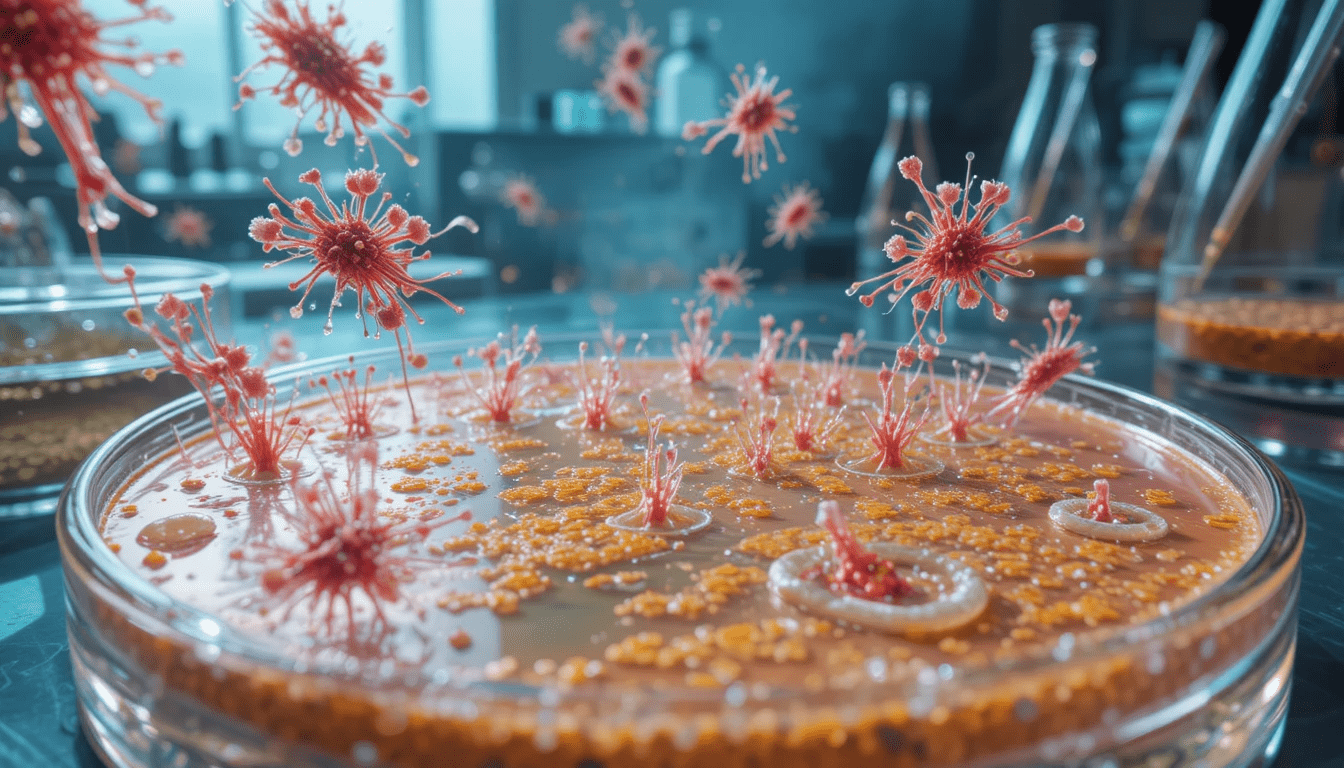
In the microscopic war for dominance, viruses are the ultimate specialists. Nowhere is this more evident than in the relationship between bacteriophages (viruses that infect bacteria) and their hosts.
For microbiology students, “Lab 14” is often a pivotal moment in the curriculum. It moves beyond simple staining techniques to explore the complex biological “lock and key” mechanisms that dictate viral infection. This experiment, centered on bacteriophage specificity, provides visual proof of how viruses select their targets.
Whether you are writing your lab report or preparing for a practical exam, understanding the underlying science of host range and plaque formation is essential.
The Core Concept: What Is Bacteriophage Specificity?
The central hypothesis of this experiment is that viruses are not indiscriminate killers. Unlike chemical agents like bleach or broad-spectrum antibiotics, a bacteriophage cannot infect just any cell it encounters.
This specificity is determined at the molecular level. A phage initiates infection through adsorption, a process where the tail fibers of the virus bind to specific receptor sites on the bacterial cell wall. These receptors can be lipopolysaccharides, teichoic acids, pili, or flagella.
- The Rule: If the specific receptor is present, the “key” turns, and the virus injects its DNA.
- The Exception: If the receptor is absent or mutated, the virus simply bounces off. The bacterium remains immune, not because it fought back, but because the virus couldn’t knock on the door.
Analyzing the Methodology: The Plaque Assay
To visualize this specificity in the lab, we cannot use a microscope to watch individual viruses. Instead, we look for the aftermath of the infection using a Plaque Assay.
This method involves the “Double-Layer Agar” technique. Students mix a small amount of phage with a bacterial culture and soft agar, then pour this mixture over a solid nutrient base. This creates a “lawn”—a cloudy, uniform layer of bacterial growth.
Interpreting the Results
The data for your lab report comes from observing this lawn after incubation.
- Positive Result (Plaques Formed):
If you see clear, circular zones eating into the cloudy bacterial lawn, infection has occurred. These clearings are called plaques. A single plaque represents a single viral particle that infected one cell, replicated, burst that cell (lysis), and released hundreds of progeny to infect neighboring cells. This chain reaction clears the area.- Conclusion: The phage is specific to this host.
- Negative Result (No Plaques):
If the bacterial lawn remains unbroken and cloudy, the bacteria grew essentially ignoring the virus.- Conclusion: The bacteria lacks the necessary receptor sites. The phage is outside its host range.
Critical Discussion Points for Your Report
When writing the discussion section of Lab Report 14, avoid simply restating your results. Instead, connect your observations to broader biological principles. Here are three key themes to explore:
1. The “Lock and Key” Mechanism
Explain why the specificity occurred. For example, if you used T4 phage (which targets Escherichia coli B), explain that T4 tail fibers specifically bind to the lipopolysaccharides on the E. coli outer membrane. If you tested T4 against Staphylococcus epidermidis, no plaques formed because S. epidermidis is Gram-positive and lacks that specific outer membrane structure.
2. Defining “Host Range”
Your data likely shows that a phage can infect one strain of bacteria but not another closely related strain. This defines the virus’s host range. Discuss how a narrow host range is an evolutionary trade-off: the virus is extremely efficient at killing its specific target, but helpless if that target is unavailable.
3. Medical Application: Phage Therapy
This lab is the foundational science behind Phage Therapy, an alternative to antibiotics. Because phages are so specific, they can be used to treat bacterial infections without harming the patient’s normal flora (good bacteria) or human cells. Mentioning this adds real-world relevance to your report.
Common Errors to Avoid
To ensure your report is accurate, watch out for these common pitfalls:
- Confusing Lysis with Inhibition: A plaque is not a zone of inhibition (like in antibiotic testing). Antibiotics stop growth; phages physically explode the cells. Ensure your terminology reflects the lytic cycle.
- PFU Calculation: If your lab involved counting plaques, remember that PFU stands for Plaque Forming Units. We count PFUs rather than “viruses” because some viral particles may be defective and unable to infect.
- Contamination: If you see plaques on a plate that should be negative, discuss potential cross-contamination. Phages are microscopic and easily aerosolized; a dropped pipette tip can ruin a control plate.
Conclusion
Lab 14 is more than just counting spots on a petri dish. It is a demonstration of molecular recognition. By successfully identifying which bacteria are susceptible to which phage, you are witnessing the precise, evolutionary programming of the viral world.
As you finalize your report, focus on the relationship between the viral tail fibers and the bacterial surface receptors. That biological handshake is the key to the entire experiment.
